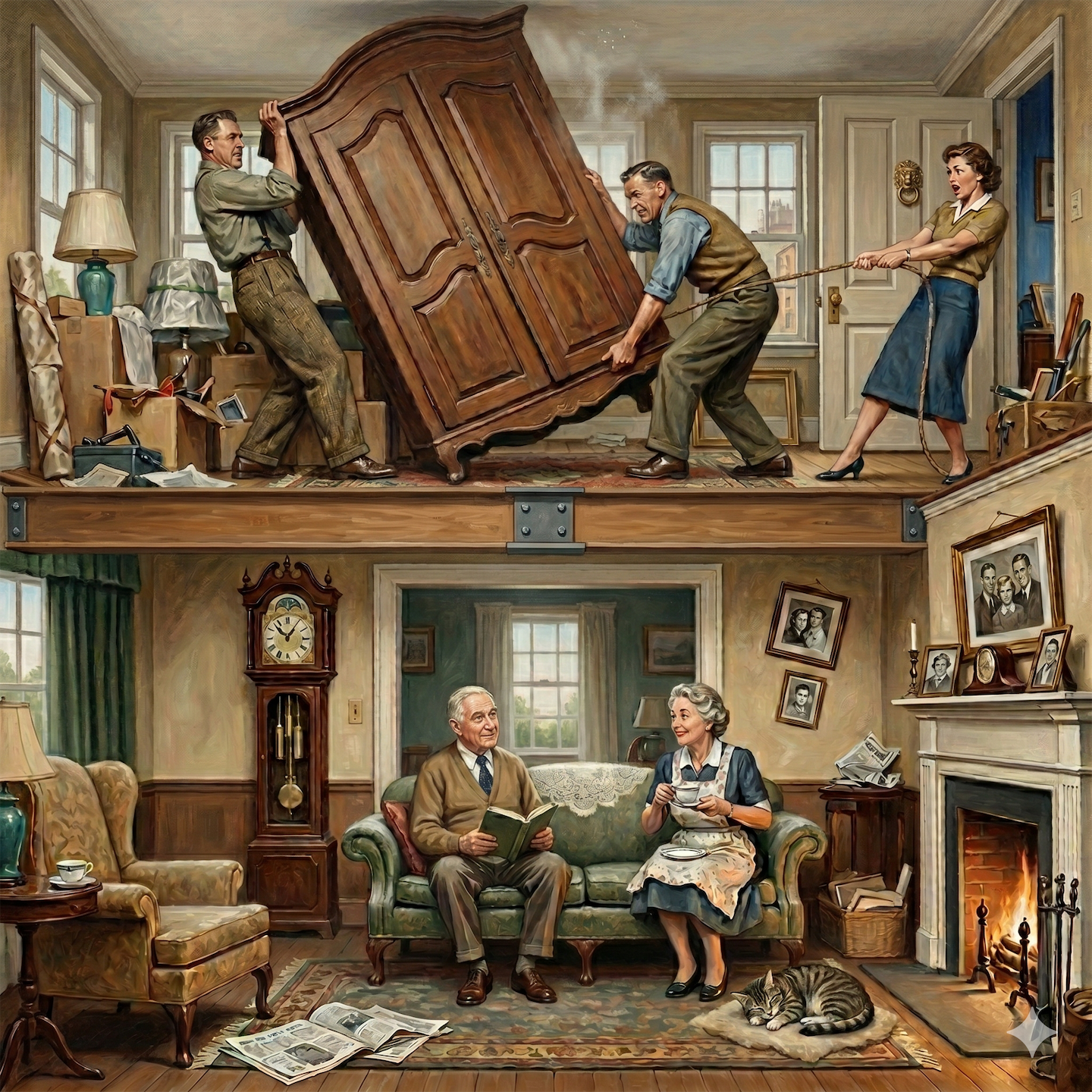
“No worries, it’s just the upstairs neighbors moving furniture around.”
For several years, the word "transformation" has become a staple in the vocabulary of any self-respecting leader. But on closer inspection, many of these transformations share a troubling commonality: they change everything at the top, and almost nothing at the bottom.
The Noise from the Top Floor
It's a familiar image for residents of old buildings: the sounds of furniture being moved, hurried footsteps, nocturnal rearrangements. Intense activity upstairs, while your apartment remains undisturbed. This metaphor holds true for many companies.
The executive committee is restructuring, scopes are changing, departments are merging, new job titles appear on the organizational chart. All of this is accompanied by enthusiastic communication about "rediscovered agility," "customer-centricity," or "a culture of innovation." Then, a few weeks later, the middle manager leading their weekly meeting asks the same question as before: but fundamentally, what has changed for me?
The answer, most often, is: not much. The furniture has been rearranged on the top floor. The lower floors haven't changed their habits.
The real obstacles to transformation — entrenched habits, unspoken issues between departments, preserved micro-powers, a culture of reporting rather than action — have remained strictly intact.
Why Transformations Remain Superficial
This phenomenon is not due to a lack of willingness from leaders. It stems from a fundamental misunderstanding of the nature of organizational change.
The executive committee's first instinct when facing a transformation challenge is structural: redrawing boxes, reassigning responsibilities, producing a new RACI, or even creating a transformation department. This is reassuring, visible, and gives the impression of having taken action. And it's not useless — but it's not enough. Because an organization is not its organizational chart. It is the sum of its members' real behaviors, day after day: how decisions are made, how disagreements are handled, what is said in the hallways and what is left unsaid in meetings, what is truly rewarded versus what is claimed to be valued.
McKinsey, in its work on the Influence Model, clearly articulated it: behaviors only change if four levers move simultaneously — the meaning given to the change, the skills developed, the alignment of recognition systems, and the "role model," the exemplary leadership. Miss one of these levers, and the transformation stops at the executive committee's door.
“Culture is what happens when the boss isn’t looking.”
This statement summarizes the core idea: it's not the values written on the walls that create the culture, but daily behaviors.
What "truly succeeding" means
Deep transformation begins with a question few leaders dare to ask aloud: what is it, in our own behaviors at the top, that undermines the challenges we aim to tackle? Because if the Executive Committee demands cross-functionality but operates in silos itself, if management advocates for initiative but punishes mistakes, if the CEO wants frankness but cannot tolerate dissent — no organizational chart change, nor any major communication plan, will be able to counteract these signals.
Profound transformation therefore requires three simultaneous shifts. First, work with the leadership team before asking the organization to change: the Executive Committee is both the sponsor and the primary focus of action. Next, build with the lower levels rather than for them — middle managers and operational teams are not targets of change; they are indispensable co-authors and actors. Finally, embed new practices in concrete rituals: a meeting with a changed format, a different way of handling disagreement, a performance indicator that measures behaviors and not just results.
It's longer. It's less spectacular than an organizational chart revised in forty-eight hours. And that's precisely why so few organizations truly do it.